
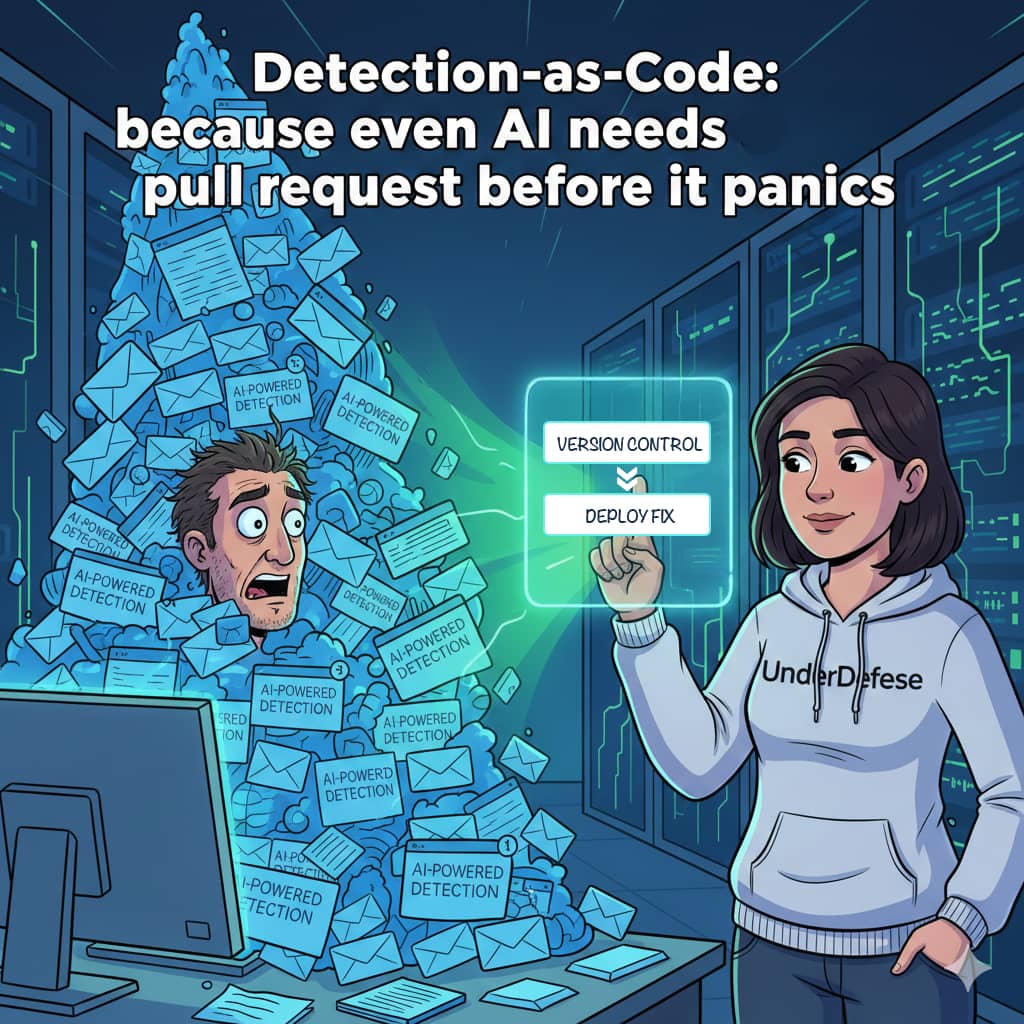
The industry has embraced AI as the antidote to alert fatigue, suppressing false positives, elevating high-confidence events, and spotting behavioral anomalies. Yet the problem isn’t AI accuracy but everything that happens after an alert fires. Traditional SIEMs and many “AI-SOCs” stop at the correlation layer. They generate insights but rarely learn from them.
Without a way to turn incident outcomes into stronger, reusable detection logic, teams end up rediscovering the same gaps again – cybersecurity’s version of Groundhog Day.
In this article, you will learn:
- Why AI-driven SOCs fail without a structured feedback loop and how Detection-as-Code fixes the “alert factory” problem.
- How treating detections as version-controlled, testable code creates adaptive, high-quality detection logic that continuously improves.
- How a human – AI closed-loop model turns incidents into measurable security and business outcomes.
The Core Problem – Alert Factories, Not Intelligence Engines
Let’s be direct: most AI-driven SOC tools are optimizing the wrong problem.
Yes, AI can reduce alert volume by 50-80% through intelligent suppression. Yes, it can enrich alerts with threat intelligence context and prioritization scores. These are valuable capabilities – tactically. But they address the symptoms of poor detection engineering, not the underlying disease.
The typical AI-SOC workflow looks like this:
- Ingest telemetry from dozens of security tools
- Correlate events using pre-built and custom rules
- Prioritize alerts using ML-based scoring
- Alert human analysts to investigate
- Contain the threat (hopefully)
- Document findings in a case management system
Notice what’s missing? The step where the organization systematically learns from what just happened.
Most SOCs perform post-incident reviews and document lessons in spreadsheets or wiki pages. But without a codified, engineering-driven process to translate lessons into validated, deployed detection improvements, the knowledge evaporates. The analyst who investigated the incident might remember the specific TTP; the rest of the team is already chasing the next alert.
AI without institutional memory is like a SOC analyst with amnesia – technically capable but doomed to repeat the same incident. That’s why organizations repeatedly get breached by the same patterns. It’s rarely the AI that failed; it’s the improvement process that doesn’t exist. The feedback loop is informal, undocumented, and dependent on tribal knowledge that walks out the door when analysts burn out from repetitive toil.
Detection-as-Code – The Foundation of Intelligent Operations
Here’s the paradigm shift: treat detection logic like mission-critical software.
Detection-as-Code (DaC) means managing SIEM queries, correlation rules, alert thresholds, and behavioral analytics as version-controlled code files (YAML/JSON) instead of point-and-click configurations hidden in vendor GUIs. This is the core practice that turns an “AI SOC platform” from a noisy alert generator into a continuously learning defense.
Rather than editing rules manually in Splunk or Sentinel, security teams:
- Define detection logic in structured files (e.g., detect_lateral_movement_t1021.yaml)
- Store these files in Git repositories with full version history
- Test rules automatically through CI/CD pipelines against representative datasets
- Validate efficacy using attack simulation tools (MITRE Caldera, Atomic Red Team)
- Deploy validated detections across all environments simultaneously
- Iterate rapidly as new threat intelligence emerges
Compounding benefits:
- Flexibility: Rules become platform-agnostic – the same definitions can target multiple SIEMs/XDRs with minimal translation.
- Auditability: Every change has clear provenance; rollbacks are trivial.
- Velocity: New TTPs are codified, tested, and deployed in hours rather than weeks.
- Rigor: Automated linting and unit tests prevent syntactic and logical errors from reaching production, reducing false positives.
Organizations implementing DaC report alert noise reductions of 82% during onboarding not by suppressing alerts with opaque ML heuristics, but by applying engineering discipline to detection logic itself.
Why DaC Enables AI-Driven SOC
Machine learning is powerful, but only when it runs on top of high-quality, well-governed inputs. If detection logic is brittle, undocumented, or full of legacy cruft, AI will optimize a flawed system.
DaC provides the reliable substrate AI needs. When detection logic is modular and continuously validated, AI can:
- Prioritize which DaC-defined detections need immediate human attention.
- Enrich alerts with contextual data structured into the rule logic.
- Trigger trusted automated responses via SOAR integration based on tested detection outputs.
Think of DaC as test-driven development for security operations. You wouldn’t deploy critical business software without tests – so why deploy detection logic without them?
The Human-AI Feedback Loop (The UnderDefense Difference)
DaC supplies the technical infrastructure for continuous learning. But infrastructure alone doesn’t guarantee learning. You need a closed feedback loop that integrates human insight, detection engineering, and AI.
The Complete Learning Loop
1. Detection & Response → Initial alert fires; SOC analysts investigate and contain the threat 2. Forensic Analysis → Incident response reveals the full attack chain, including detection gaps 3. Detection Engineering → Gaps translate into refactoring tasks: new DaC rules or tuning of existing logic 4. Validation & Deployment → Automated testing validates rule efficacy; CI/CD pipeline deploys globally 5. Strategic Communication → Technical improvements translate into business risk reduction metrics 6. Continuous Monitoring → New detection logic proves itself in production; cycle repeats
Most AI SOC platforms and traditional MDR services excel at detection and forensic analysis. Then they stop. The critical translation steps – turning forensic findings into engineered detection improvements, and communicating those improvements as measurable business value – are left as “the customer’s problem.”
Why This Creates Strategic Failure
Research shows that over 70% of strategic plans fail due to execution breakdown, not poor ideas. In cybersecurity, that gap looks like: knowing what needs fixing but failing to prioritize, fund, or implement it.
A technical finding like “missing endpoint agent on 15% of servers” sits in a post-incident report. The SOC team understands the risk. But without translation into executive-facing language (quantified financial risk, compliance exposure, operational impact) the fix doesn’t get resourced. Six months later, the same gap enables another breach.
UnderDefense’s model closes both loops:
- Technical Loop: Dedicated detection engineering manages 1,000+ correlation rules as code with CI/CD. Incident response gaps become prioritized engineering work tracked in version control.
- Strategic Loop: Monthly Business Risk & Impact Reports translate technical improvements into executive strategy. Instead of “we added detection rule X,” customers hear “we eliminated a $10M fraud risk by closing detection coverage on ERP lateral movement TTPs.”
Framing detection improvements as quantified business risk forces execution: security work competes for budget on the same terms as other initiatives.
From Alert to Action – Measurable Outcomes
Here’s how outputs differ between traditional AI-detection tools and a DaC-driven managed SOC:
Traditional AI-SOC outputs
- Alert notifications with priority scores
- Technical incident summaries
- Lists of affected systems
- Recommendations (“consider deploying agent on server group X”)
Adaptive DaC-driven SOC outputs
- Validated Incident Notifications – Alerts pre-enriched with MITRE ATT&CK mappings, asset context, and automated containment status (average triage: under 2 minutes).
- Proactive Vulnerability Alerts – Detection coverage gaps identified before exploitation, with remediation logic ready to deploy.
- Quarterly Posture Improvement Plans – Business-justified roadmaps showing how detection engineering reduces compliance and financial risks.
- Continuous Tool Optimization – SIEM/XDR rule refinement reducing noise by 70–82% while improving coverage.
The difference is clear: AI generates alerts; an intelligent, managed SOC produces outcomes.
Real-world example: Your SOC detects lateral movement via LSASS credential dumping (T1003.001). A standard MDR provider contains the threat and issues a 15-page report. An adaptive SOC powered by DaC does that – and then:
- Engineers a targeted detection rule tuning for the credential-access pattern observed.
- Tests the rule against historical logs to confirm earlier detection.
- Deploys the rule across production via CI/CD.
- Reports to leadership: “This incident exposed a $2.5M data-exfiltration risk due to delayed credential-theft detection. We deployed validated detection logic and reduced Mean Time to Detect for this TTP from 4 hours to 8 minutes, closing a critical PCI-DSS control gap.”
One approach delivers a historical record. The other delivers hardened future defense plus the business justification to retain funding.
Why This Model Scales Smarter, Not Louder
Many “AI-SOC” scaling strategies simply hire more analysts to process more alerts. That increases capacity but not learning. Without Detection-as-Code and structured feedback loops, scaling up means more manual investigation, more siloed knowledge, and more gaps.
True SOC maturity requires three integrated pillars:
- Automation (AI + SOAR): Machine intelligence handles enrichment, correlation, initial triage, and routine containment. This eliminates the ~80% of toil that causes burnout.
- Governance (DaC + CI/CD): Detection logic is managed like software: version control, automated tests, continuous validation, ensuring incident learnings are systematically implemented.
- Expertise (Human Oversight + Strategic Translation): Skilled analysts hunt, refine detection logic, and translate findings into business-justified strategies that mandate execution.
When those pillars integrate, the SOC becomes a system that thinks (AI pattern recognition), learns (DaC feedback loops), and teaches (risk communication that drives organizational improvement).
This is why UnderDefense emphasizes the full lifecycle – detection and response plus engineering and strategy – transforming tactical wins into sustained posture improvement.
The Bottom Line for Security Leaders
If your current SOC or MDR provider delivers incident reports but leaves you to figure out how to fix root causes, you’re operating with half a program.
AI detection is table stakes. The differentiator is what happens after the alert: can your security operations convert incidents into validated, deployed improvements? Can they communicate those improvements in terms that justify ongoing investment?
Detection-as-Code is the operational infrastructure that makes an AI-driven SOC accountable rather than merely automated.
UnderDefense’s fully managed SOC with an integrated AI Co-Pilot transforms alert fatigue into adaptive security learning – through engineering discipline: correlation rules managed as code, sub-2-minute triage, and monthly reporting that ties technical work to business risk reduction.
The future of security operations isn’t faster alerting – it’s faster, codified learning. Build systems that remember.
Ready to see how a SOC built on engineering principles performs? Explore UnderDefense’s Managed SOC services or schedule a MAXI AISOC demo to see how Detection-as-Code closes the improvement loop competitors leave open.
Need help now?
UnderDefense’s Security Team is available 24/7. Immediate triage, containment, and forensic assistance.
FAQs
1. What is an AI-driven SOC and how does it differ from a traditional SOC?
2. What is “Detection-as-Code” and why is it important for an AI SOC platform?
3. How does a managed SOC use DaC to reduce alert noise?
4. Can SOC automation replace human analysts?
5. How does Detection-as-Code support compliance and executive reporting?
The post Beyond Alerts: Why “Detection-as-Code” Is the Missing Link in AI-Driven SOCs appeared first on UnderDefense.
